Why Your Shopify Live Chat Is Really an Email Queue
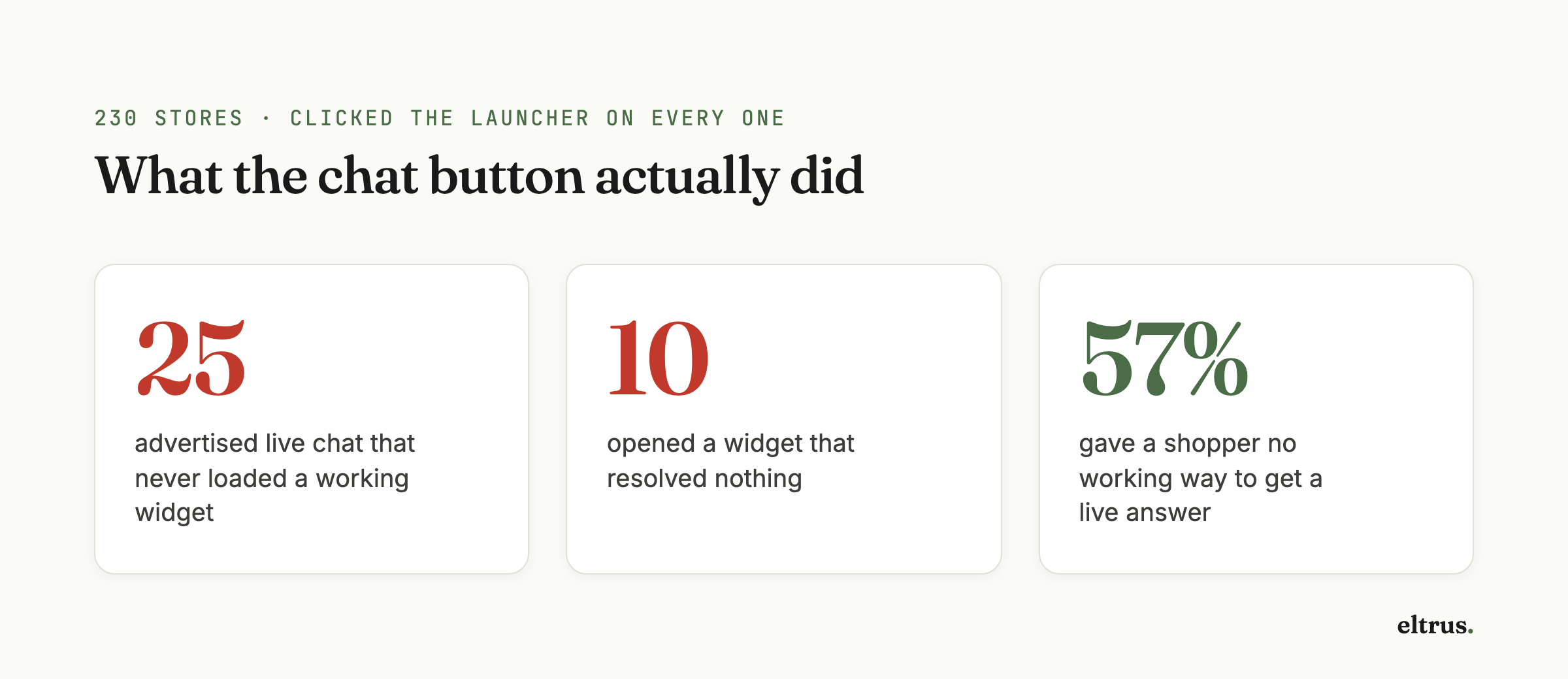
I clicked the live chat button on 230 Shopify stores. 25 advertised chat that never loaded, 10 opened and resolved nothing. Here is how to tell if yours does.
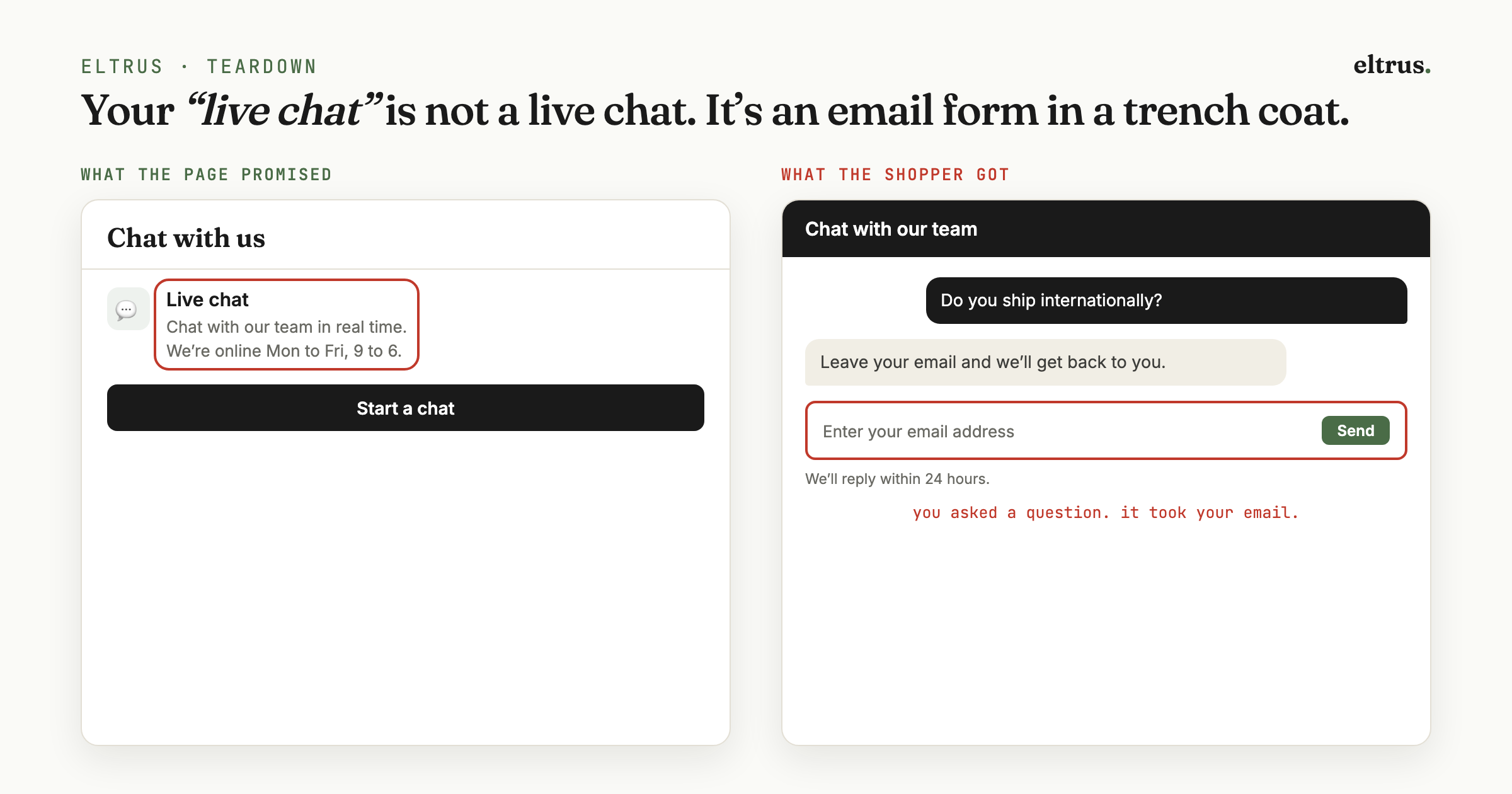
I clicked the chat button on 230 Shopify stores to find out what it actually does. Most of the time, it asks for your email and promises a reply.
That is not chat. That is a queue with better branding.
What the button actually does
I run every store as a logged-out shopper, in a real browser, the way a customer hits it cold. Click the launcher. Type a real question. Watch where it goes.
On 25 of the 230, the contact page advertised live chat that never loaded a working widget at all. The button was there. Nothing opened. On another 10, a widget opened and resolved nothing. It mounted, it looked alive, and there was no path to an actual answer.
The disguises are specific, and I logged each one as I kept catching it. The most common is a composer with an email field and a line that reads “we’ll reply within X”. You think you are chatting. You are filling out a contact form with a typing animation. The other is the gated version. You type your question, you hit send, and the composer swaps itself for a required name-and-email form before a single word reaches anyone.
Two you can check yourself in one click, right now.
One supplement brand on a paid helpdesk opens to six fixed buttons (shipping, discounts, a couple of dietary questions, delivery) then “leave a message”. Ask anything outside those six and you get nothing but a message box. A beauty-device brand skips the pretence entirely. The widget opens straight to a name-and-email gate. You cannot type a word until you hand over your contact details.
Both of those are live. Go and look.
The tool was never the problem
Here is the part that should sting if you bought one of these. Sixty of the 230 stores ran a real paid helpdesk fingerprint, 48 of them Gorgias. Thirty-five of those still had a chat that exists, mounts, opens, and answers nothing.
The seat is paid for. The widget is installed. It still funnels every real question into the email inbox it was supposed to replace.
Buying Gorgias does not buy you answers. Somebody has to write the knowledge in your voice and tune the thing to handle the question that isn’t on the menu. Most founders never do, so the expensive widget becomes a costumed inbox. The tool ships as DIY. Nobody told you that when you bought it.
Where the money actually leaks
This one is not a cost line, and that is exactly why it is bigger than it looks.
Picture the shopper with a pre-sale question. Is this my size. Will this react with my skin. That question arrives at the one moment they are ready to buy. They click the thing that says chat, they ask, and they get “we’ll email you back”. So they leave. The button captured an email and lost the cart.
Run the rough numbers. At an AOV of 100 and a 14% ticket ratio, a 5 million euro store fields somewhere around 585 tickets a month (modelled, from our GMV economics work). The pre-sale slice of those is abandoned-cart fuel. The handling cost of a ticket, the 3 to 7 euro of agent time, is the small number here. The lost sale dwarfs it.
A chat that captures an email is worse than no button at all. It spends the shopper’s trust at the exact decision point and gives nothing back. Then the question it failed to answer often comes back as a public one-star. You never replied complaints show up 940 times across the low-star tails I read. Being ignored is the thing people post about.
What chat actually means
A chat button that only captures an email is a lead-capture form for your own support backlog, branded as help.
If your widget cannot answer “where is my order” and “can I return this” in the thread, it is not chat. You did not buy chat. You bought a costume for your inbox, and the shopper paid for it in trust.
There are three honest options here, and the one almost everyone picks is the worst of them.
Take the button down. Honest. The shopper knows to email and waits accordingly.
Make the button answer. Best. The question gets resolved in the session, the cart survives.
Leave up a live-looking widget that funnels every real question to a 24-hour reply. Worst. It harvests the trust of someone who genuinely believed they could get an answer now, and hands them a form. That is the costume. That is what most stores are running.
So check your own. Open your store on your phone, logged out, like a stranger. Click your chat button and ask it where your order is. If it asks for your email, you have your answer, and so does every shopper who tried it before you.
Either make the button answer or take it down. I tear down stores like yours for a living, and the free sample audit will tell you in plain language which of the three yours is running. If you already know it’s the third one, say so and I’ll send the fix.