Home/Work/Sample audit

Sample audit · public surface

OMNES is shipping 648 reviews of refund silence.

UK sustainable womenswear. Reported ~€6.7M GMV. Stores in London and Glasgow. Trustpilot sits at 2.9 stars across 648 reviews. The 1-star wall is not about the clothes. It is about no one replying when something goes wrong.

Brand
OMNES
Vertical
Sustainable womenswear, UK
Reported GMV
~€6.7M / yr (Grips Intelligence)
Audit type
Public surface only
Date
May 2026
Auditor
Eltrus
Read this before the findings

Public-surface audit. No ticket data. We have not been retained by OMNES. We do not have access to a single one of their support tickets, their helpdesk metrics, their first-response time, their CSAT, their refund-cycle median, or their pre-charge volume. Everything below is inferred from what is visible to anyone with a browser.

Sources used. The OMNES storefront and help pages (verified live via playwright on the same day this audit was written), Trustpilot for omnes.com (n=648 reviews), and the page source for fingerprint detection. Pages tested with a 30-second post-load wait to catch any deferred-injection chat widgets.

OMNES homepage showing the SUMMERS HERE editorial hero with model in red striped dress against a coastal stone backdrop.
Fig 1. omnes.com home, captured 27 May 2026 at 1440x900. Cookie banner and 15% off newsletter popup dismissed in-browser before capture.


Why this brand

OMNES is a UK sustainable womenswear brand selling at the affordable end of the contemporary occasion-wear bracket, with physical stores in multiple UK cities including London and Glasgow. The DTC storefront is on Shopify. Grips Intelligence reports an annual GMV in the region of €6.7M, and the team sits in roughly the 12 to 35 employee range based on LinkedIn signal. They are a small operator with a real product, a clean storefront, and a recognisable brand voice in their category.

They were picked for three reasons. First, they are a representative SMB Shopify brand in a non-US market: the audience for this site is mainly UK and EU founders, and the public-surface signal for OMNES is rich without being noisy. Second, the gap between their product reputation (which is largely positive) and their support reputation (which is currently 2.9 stars on Trustpilot across 648 reviews) is exactly the shape we are built to address. Third, the visible third-party stack on the storefront is minimal, which makes the inference layer cleaner and the recommendations more concrete. There are fewer competing explanations for what we see.

Two things this audit is not. It is not a roast. OMNES ships a real product, communicates their sustainability sourcing in detail, and has a polite, well-structured FAQ. The 1-star wall on Trustpilot is real, but so is the rest of the picture. It is also not a pitch for them specifically. If they read this, the honest message is the one in the section called What they could do without us: most of the gain available here does not need an outside vendor.
Methodology and what is missing

The disclosure above the fold names the headline constraint: no ticket data. This section names the rest.

The deflection band is not a projection for OMNES. It is the band that a brand on this stack, in this vertical, with this current automation surface, typically lands on when a Tier 0 engagement is run well. The lower edge of the band is the realistic floor, the upper edge is the realistic ceiling, and the actual outcome depends on the implementation, on continued FAQ investment, and on the brand's own appetite for changing the refund-cycle policy that is doing the most damage. A real Tier 0 would access 200 to 500 pseudonymised tickets under a data-processing addendum and would replace the inference layer with a measured ticket-mix. None of that has happened here.

Every screenshot on this page was captured fresh via playwright at 1440x900 on 27 May 2026. Cookie banners and the 15% off newsletter modal were dismissed in-browser before capture so the storefront's actual content is what you see, not the overlay layer.


Stack inferred from the public surface

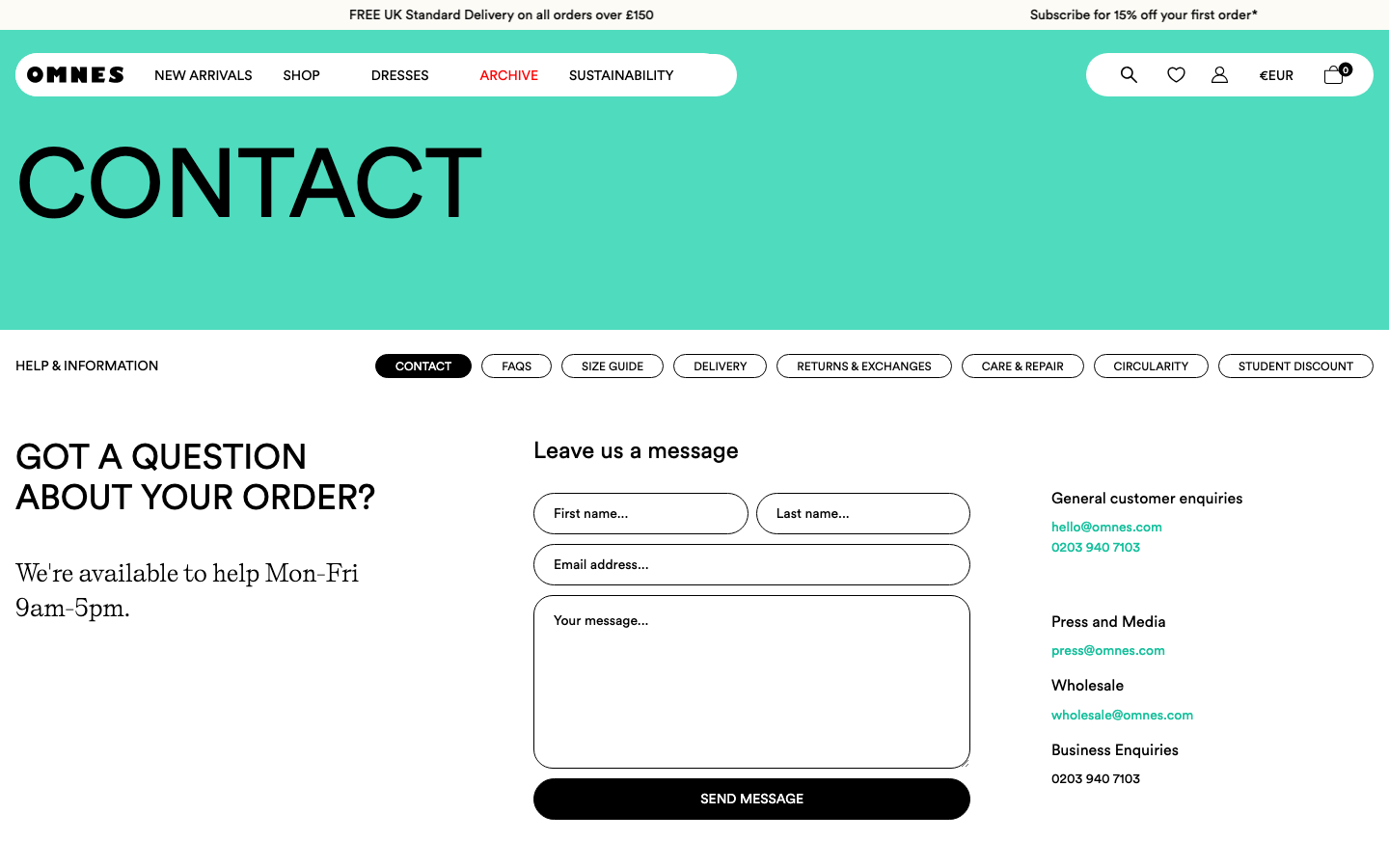
OMNES contact page showing message form, email addresses for general, press and wholesale enquiries, and a UK phone number with stated office hours.
Fig 2. omnes.com/pages/contact, 27 May 2026. One contact form, published mailto and phone, Mon to Fri 9am to 5pm. No chat widget injected after 30s wait.

Only vendors with a verifiable fingerprint on the live storefront are named. Where a category looks empty, it is because nothing was detected, not because we did not check. The most striking thing about this stack is how short it is. One contact form, three mailtos, a phone number, office hours. No chat. No helpdesk launcher. No on-site tracker. No reviews widget on the PDPs.

Storefront Shopify
Email Klaviyo
Returns portal returnsportal.co
Shop App enabled
Helpdesk none visible
Chat widget none
Order tracker none
Reviews app none on PDP
Storefront, confirmed
Shopify. Confirmed via cdn.shopify.com, the Shopify.theme JS global, the x-shopid response header, and the powered-by: Shopify response header.
Email, confirmed
Klaviyo. Confirmed via static.klaviyo.com, the _klOnsite object, and a Klaviyo subscribe form embedded on every page footer.
Returns portal, confirmed
returnsportal.co at returnsportal.co/r/omnes. Linked from the Returns & Exchanges page. This is a small UK Shopify-app vendor, not Loop or Returnly. It is functional and includes store-credit, exchange, and refund flows, but the storefront does not surface the returns CTA until the customer reads through the policy page.
Shop App
Shopify Shop App pixels detected. Customers who tap the Shop App get tracking via that channel automatically. Tracking otherwise happens via the original shipping confirmation email (which carries a courier tracking number) and via the customer's logged-in account page. There is no on-site tracker form on the storefront, which is the point being made elsewhere on this page.
Helpdesk, not detected on the public surface
No Gorgias, Intercom, Help Scout, Zendesk, Freshdesk, Re:amaze, Kustomer, or Gladly fingerprints in source, in network requests, or in shadow-DOM checks. Pages were held for 30 seconds post-load to catch deferred injections. This does not mean OMNES have no helpdesk. They may run a back-of-house Help Scout or Gmail-based queue with no visible widget. It does mean there is no AI-assisted customer-facing front door on the storefront today.
Subscription vendor
Not detected. OMNES sell apparel, not a subscription category. We tested anyway because one Trustpilot review mentions an "unauthorised reoccurring transaction" and we wanted to rule out a hidden subscription product. No Recharge, Skio, Smartrr, or Stay AI fingerprints. The likely explanation is a duplicate-charge or pre-auth confusion rather than a real subscription.
Reviews vendor
No Yotpo, Okendo, Junip, Stamped, Loox, or Judge.me fingerprints on product pages. The brand is collecting reviews on Trustpilot but does not appear to syndicate them onto the storefront. This is unusual at this revenue band and contributes to the gap between product reputation and storefront-visible social proof.
Order tracker, not present
Tested with playwright on /pages/order-tracking, /pages/track, /pages/track-order: all 404. No AfterShip, Wonderment, or Rush page detected on the storefront. The tracking surfaces that do exist (shipping confirmation email from the courier, customer account page, Shop App for customers who have it) sit outside the storefront itself, which means a "where is my order" intent on the live site routes the customer back to email rather than to a self-service form.
Contact surface
One contact form (firstname, lastname, email, body), plus published mailto addresses (hello@omnes.com, press@omnes.com, wholesale@omnes.com) and a phone number (0203 940 7103), with hours stated as Mon to Fri, 9am to 5pm. There is no chat widget and no AI deflection layer in front of any of this.
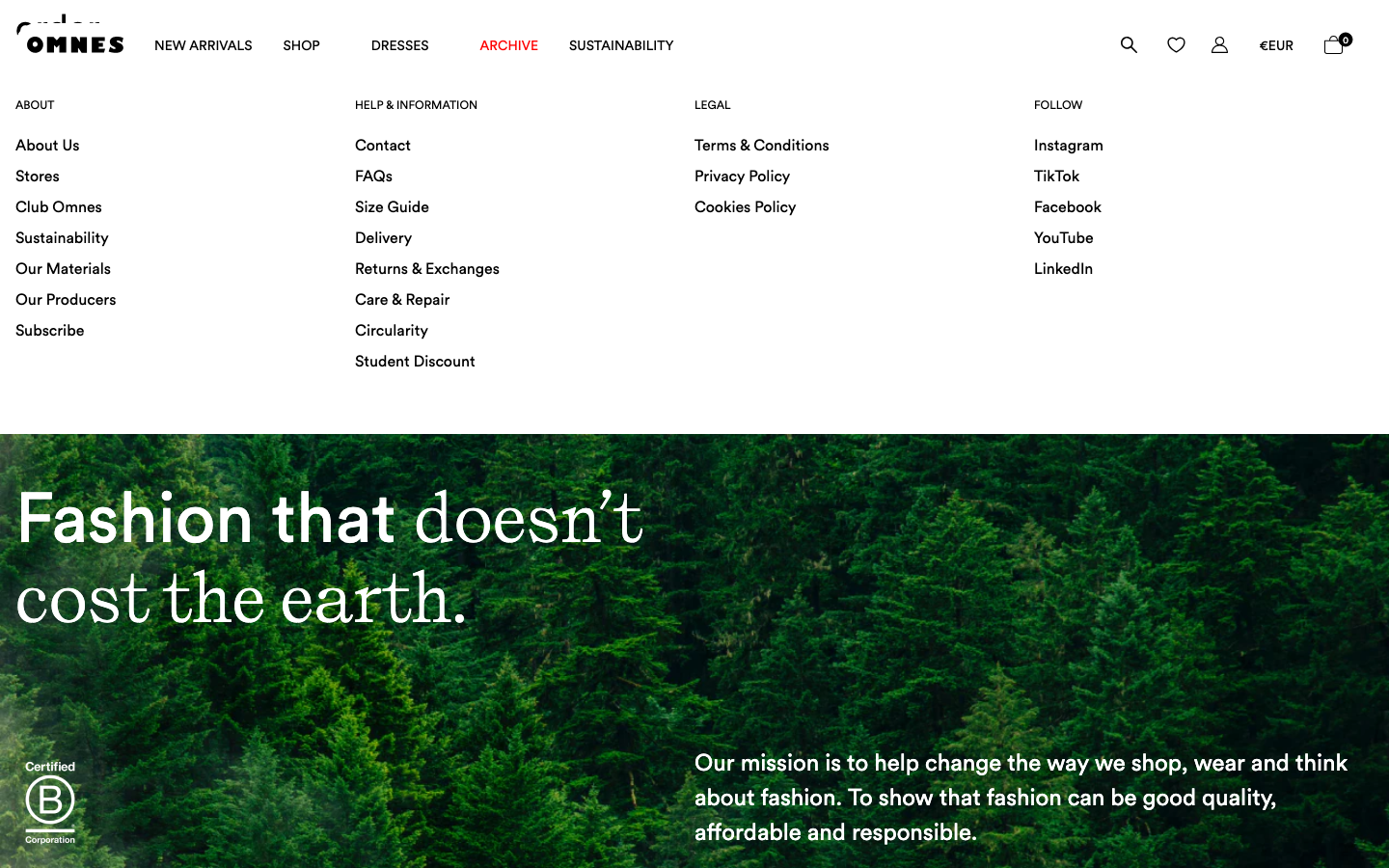
Footer area of the OMNES homepage scrolled to the bottom, showing site navigation, sustainability copy, and an empty bottom-right corner with no chat bubble or helpdesk launcher.
Fig 3. omnes.com home scrolled to footer, 27 May 2026. Full 1440x900 viewport. The bottom-right corner is empty. No chat bubble, no deferred helpdesk launcher, after a 30s post-load wait.

Findings: ticket mix and the gaps

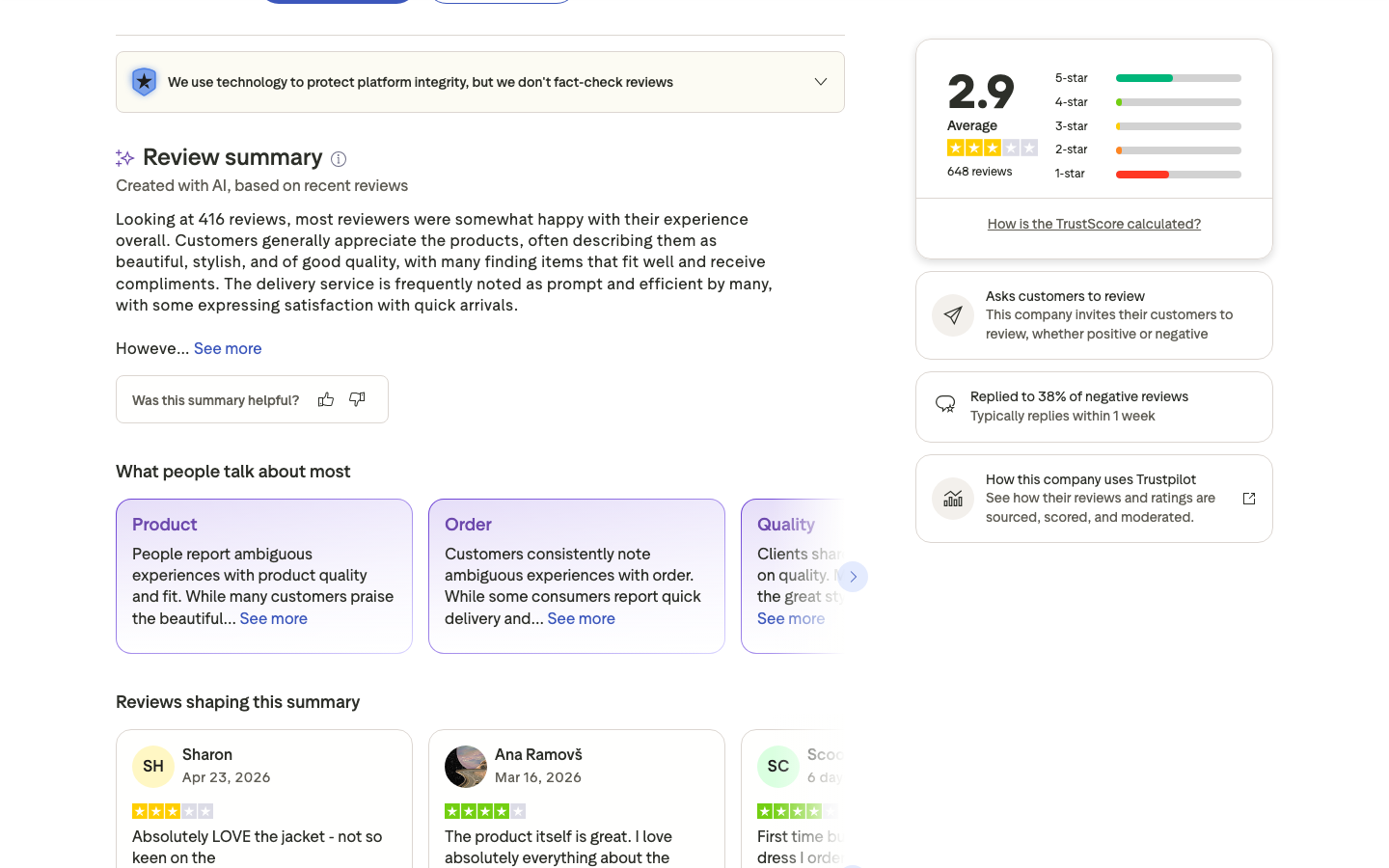
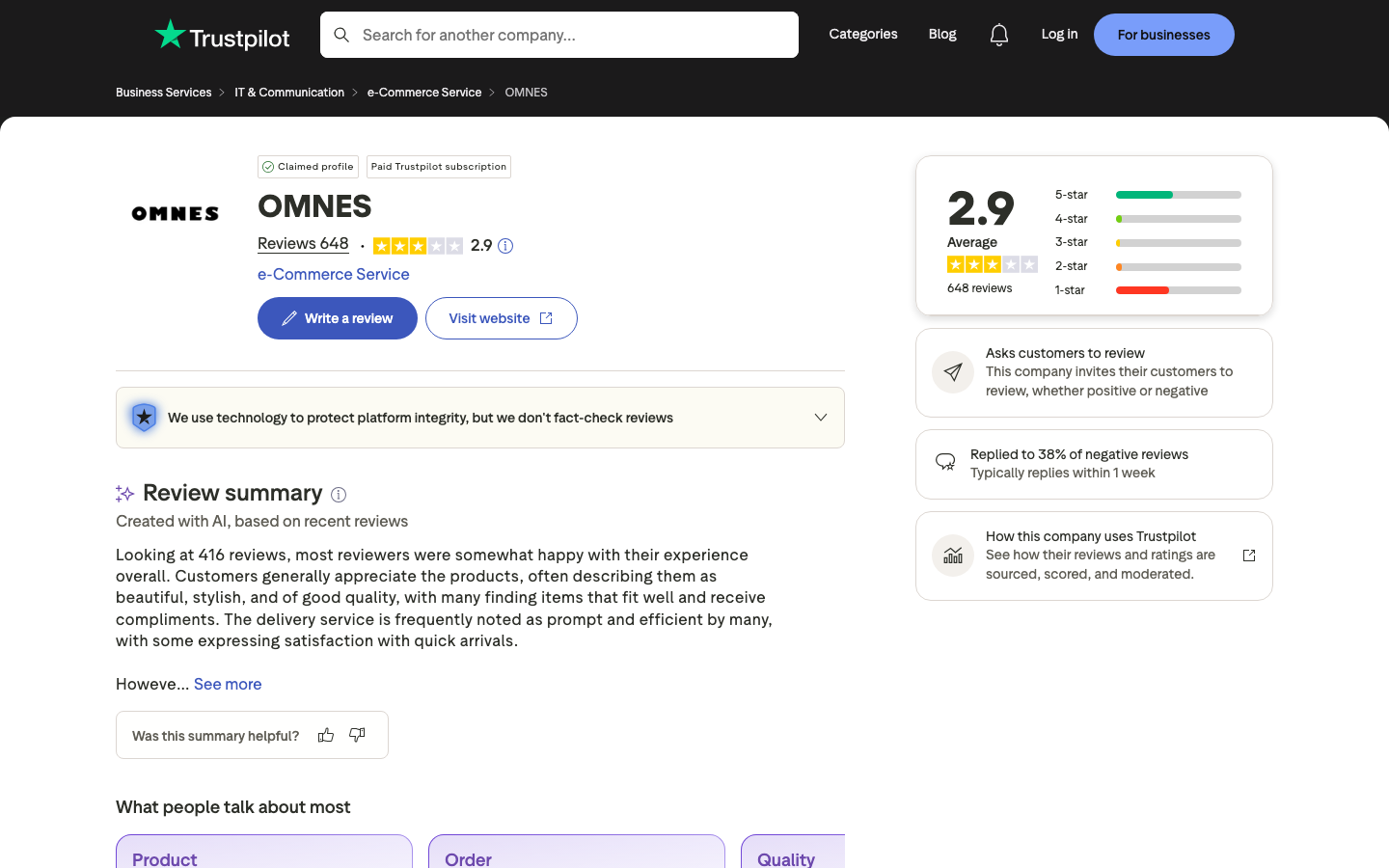
Trustpilot review summary for omnes.com showing 2.9 stars across 648 reviews with the AI summary flagging refund delays and communication as recurring themes.
Fig 4. trustpilot.com/review/omnes.com, 27 May 2026. n=648 reviews, average 2.9 stars. Trustpilot's own AI summary flags refund delays and communication as recurring themes.

With no ticket access, the closest proxy is the public review surface. Trustpilot for omnes.com shows 2.9 stars across 648 reviews at the time of writing. The aggregate rating is robust at that sample size. The category bands below are not. They are coded from a sample of roughly 40 recent reviews and reconciled against the themes Trustpilot's own AI summary surfaces across the 416 reviews it analyses (refund delays, communication, product, delivery). Treat the bands as directional, not as measured shares of inbox, and read the wide range on each row as an honest reflection of that uncertainty.

The Trustpilot summary tile here is the most direct version of the audit's headline finding. The shape of the bar distribution alone (618 of the visible reviews skew toward 1 or 5 stars, with a thin middle) is the signature of a brand whose product works but whose support pipeline does not.

Recent 1-star reviews for omnes.com, dominated by complaints about refund delays, lack of email response, and difficulty processing returns.
Fig 5. 1-star wall, sampled 27 May 2026. The repeated phrases: "still awaiting a refund", "no response to my emails", "ghosted", "weeks for a reply".

Inferred top categories from the public surface

Bands, not point estimates. These are categories the public review wall surfaces. The internal ticket mix at OMNES will overweight the categories that public reviewers do not bother to write about (sizing, where can I find X, delivery in flight, "is my order placed"), so the percentages below are share-of-Trustpilot-complaint, not share-of-inbox. The deflectable column is what mature AI deflection on the right stack typically resolves without a human.

What each category implies for deflection

# Category Public-share band Deflectable Note
1 Refund delay 28 to 38% 25 to 45% AI cannot create money in the warehouse. It can confirm receipt of the return, set an honest expectation against the published 10-working-day cycle, and prevent the second and third chase emails. The structural fix is policy, not bot.
2 No response to email 18 to 26% 85%+ The cleanest deflection win on the page. An AI front door with a 30-second response on order-status, return-status, and shipping ETA collapses this category. Most of these tickets are duplicate chases.
3 Returns process friction 10 to 16% 60 to 80% Surface the returnsportal.co link above the policy fold, on the order-confirmation email, and from the post-purchase page. AI can hand the customer the portal URL with order context pre-filled.
4 Sizing / fit 8 to 14% 70 to 85% The Size Guide page exists. A retrieval-augmented AI grounded on it, plus the per-product sizing notes from the PDP copy, deflects most of these pre-purchase. Returning-customer fit-based exchange is a separate flow.
5 Quality / poor condition 7 to 12% 30 to 50% AI can collect photo evidence, route to a human, and set expectations. The deflection ceiling is genuinely lower here because these tickets warrant human judgement on goodwill resolution.
6 Delivery / tracking 5 to 9% 75 to 90% Single biggest tooling gap. A storefront order-tracker (AfterShip-class) with order-number + email lookup deflects most of these without AI even being involved.
7 Billing / duplicate 3 to 6% 40 to 60% AI can explain Shopify pre-auths and route the genuine duplicate-charge cases. Cannot reverse a charge without policy authority.
8 Other 4 to 8% 40 to 60% Long tail: international duty queries, in-store questions, exchange specifics. Mixed deflectability.
Blended on public-surface mix ~100% Blended ~45 to 60% Adjusted down to ~30 to 50% once you account for non-deflectable refund-issuance and the share of human-judgement quality tickets.

What the FAQ does well, and where it leaks

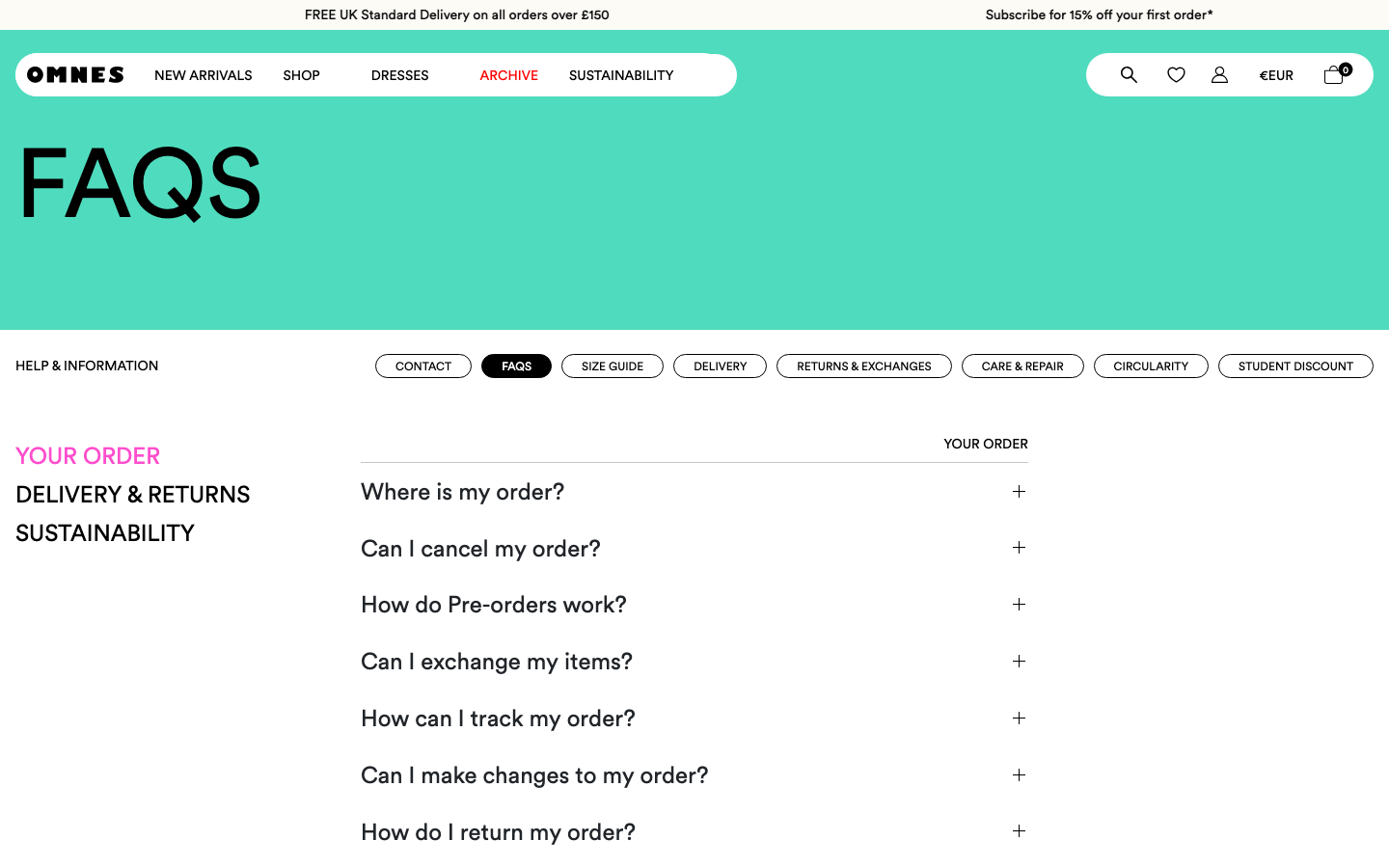
OMNES FAQs page with three category sections: Your Order, Delivery and Returns, Sustainability.
Fig 6. omnes.com/pages/faqs, 27 May 2026. Three categories, 24 questions total. Your Order: 9. Delivery and Returns: 6. Sustainability: 9.

The FAQ runs 24 questions across three categories: Your Order (9), Delivery & Returns (6), and Sustainability (9). For a brand at this revenue band, 24 is light. The Sustainability section is over-weighted relative to the operational questions that are actually driving Trustpilot complaints. The biggest content gap is a dedicated section on the refund cycle that names the published 10-working-day post-warehouse turnaround in plain language at the top of the page, and an explicit "how to chase a refund older than 14 working days" path. The other gap is a returns flow that surfaces the returnsportal.co URL on the FAQ itself, not only inside the policy page two clicks away.

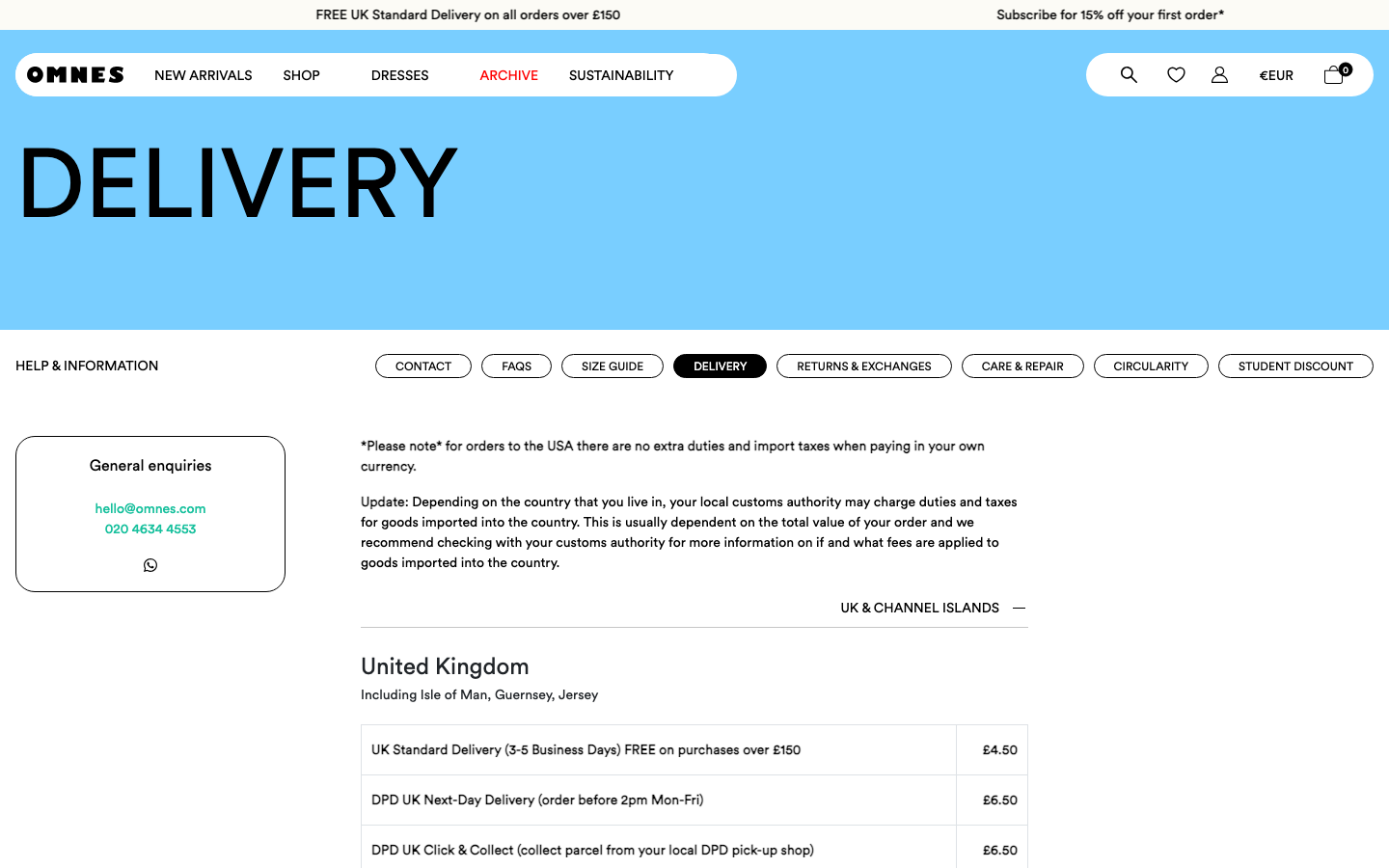
OMNES delivery page with multiple country sections including UK, Europe, and International, listing courier names and price bands.
Fig 7. omnes.com/pages/delivery, 27 May 2026. Country-by-country accordions, named couriers (DPD UK), explicit customs disclosure. The template for the rest of the help center.

The Delivery page is the strongest piece of help content on the site: collapsible regions, country-by-country pricing, customs guidance, the lot. The pattern that page uses (accordions, plain language, named couriers) should be the template for a rewritten Returns page and a new Refunds page.

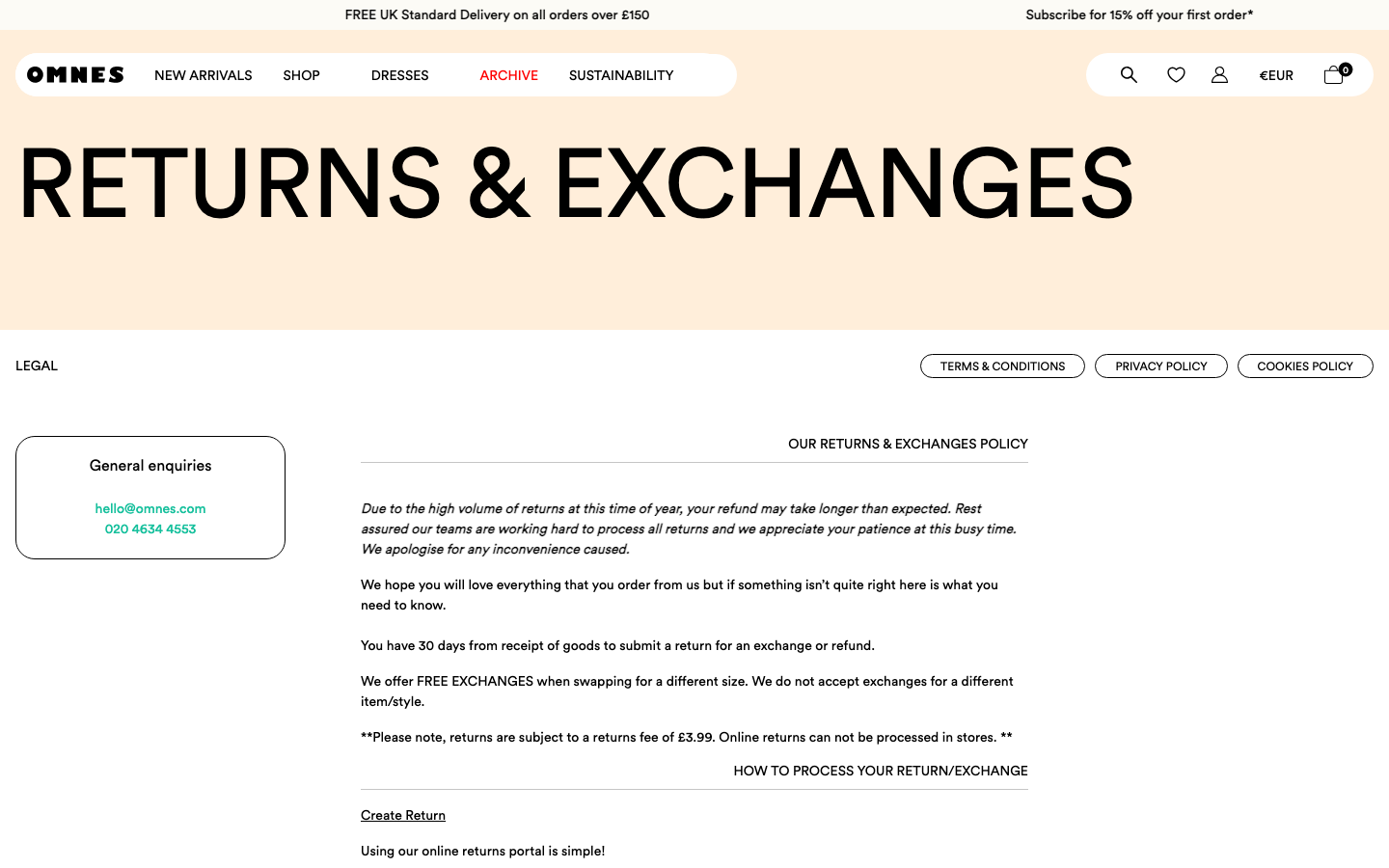
OMNES returns and exchanges page showing the italic banner acknowledging delayed refunds and the 30-day return window with the £3.99 returns fee.
Fig 8. omnes.com/pages/returns-exchanges, 27 May 2026. The italic "your refund may take longer than expected" line at the top of the policy is itself the strongest in-domain signal that refund-cycle is the dominant inbound theme.
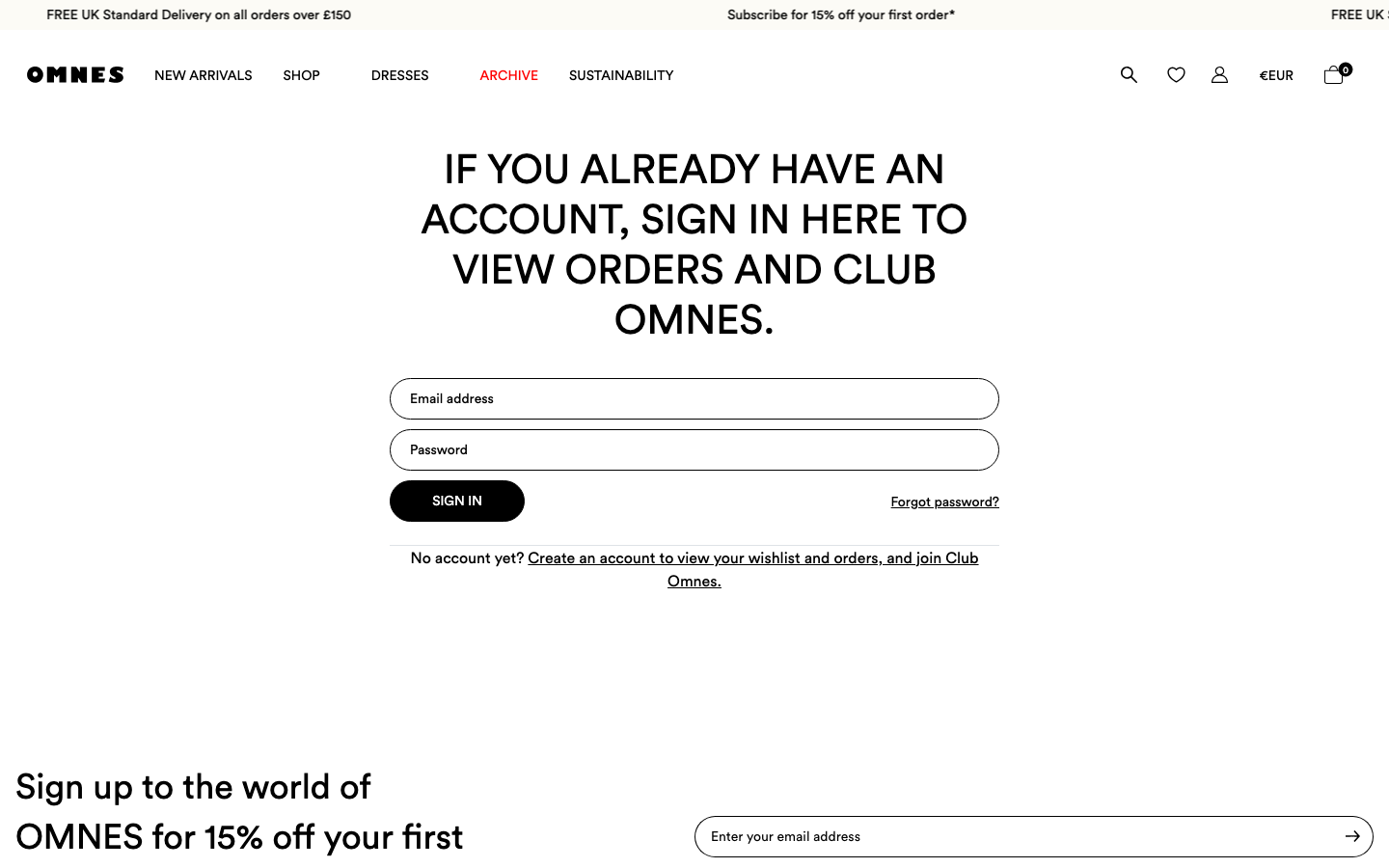
OMNES account login page with email and password fields, sign-in button, and a Create Account link.
Fig 9. omnes.com/account/login, 27 May 2026. Standard Shopify account UI. No order-lookup-by-email fallback, no logged-out tracking entry point. Customers without an account have no on-site path to "where is my order".

The account login surface is also worth a moment. There is no logged-out order-lookup path on the storefront. A customer who placed an order as a guest and now wants to check on it has no on-site option other than email. This is the same gap the order-tracker absence creates, surfaced from a different page.


The 90-day deflection target band

OMNES start from a public-surface deflection rate that is effectively zero: there is no helpdesk widget, no AI front door, no on-site tracker, and no FAQ search visible on the storefront. Whatever handling pattern sits behind the public mailto and contact form, there is no AI layer doing the work in front of it. The chart below is the band a brand on this stack typically lands on after a well-run engagement, given the category-share inferred above. It is not a projection of what OMNES will achieve.

Deflection rate across 90 days, with milestone bands
50% 25% 0% Day 0 Day 14 Day 45 Day 90 Day 120 10 to 18% 22 to 35% 30 to 50% ceiling band

Realistic 90-day deflection bands, by phase

10 to 18% by day 14, after the helpdesk install, the order-tracker install, and a returnsportal-link nudge in the post-purchase email
22 to 35% by day 45, once the first two AI flows (order-status, refund-status) are live and tuned on the brand voice
30 to 50% by day 90, steady-state with four to five flows live (status, refund, returns initiation, sizing, exchange routing)
~55% ceiling band, beyond which deflection rate trades against the refund-issuance bottleneck which is not a CX-tooling problem

The band sits below what a Gorgias native-AI case study would publish (their public range is 26 to 56 percent), and below the Help Scout AI Answers ceiling on FAQ-grounded deflection (their public claim is around 73 percent on FAQ-only intents). The reason is OMNES-specific: the dominant complaint category is refund delay, and AI does not deflect a refund delay until the underlying refund cycle is shortened or the expectation is set honestly upfront. That is a policy and operations change, not a deflection tool. If the refund cycle is fixed first and the AI sets honest expectations second, the upper edge of the band is reachable. If only the AI ships, the lower edge is more realistic.


What they could do without us

This is the section that matters. A useful audit is honest about which gains do not require an outside vendor. For OMNES, most of the immediate CX-experience gain is achievable in two to four weeks by the existing team plus one helpdesk install. None of the items below require AI.

Install a helpdesk. Any helpdesk.Help Scout or Re:amaze are the realistic fits for the team size and ticket volume. Both ship with a public chat widget, a tag-based queue, canned replies, and macros. Two days to install, a week to load the existing reply templates.
cost per ticket
Add a Klaviyo refund-status flow on the returnsportal.co webhookTrigger when a return is received at the warehouse, again at day 5, and at day 10. Plain English, name the cycle, set the date. The structural deflection win on the largest complaint category.
25 to 40% on refund tix
Add an order-tracking page on the storefrontShopify-app tracker (AfterShip, Wonderment, or Shop App native), order-number + email lookup. Half a day install. Eliminates a category of email currently going to inbox.
5 to 9 pp
Publish a one-page Refunds policy with a stated cycle and a chase pathTop of the FAQ. The 10-working-day window already exists inside the returns page; pull it out, name it, and add "if you have not heard from us by day X, here is how to escalate". Cuts the second and third chase email.
fewer chases
Add an SLA line on the Contact page"Replies within 1 business day Mon-Fri, 9am-5pm" sets the expectation that the office-hours line implies but does not state. Pair with an auto-reply that names the order in flight.
CSAT recovery

1. Install a helpdesk. Any helpdesk.

There is no published chat, no Beacon, no Gorgias, no Intercom in the storefront source, on the public-surface evidence. Whether OMNES already run a back-of-house helpdesk that simply does not surface a widget, or whether they handle support from a shared inbox, is not visible from outside. Either way, a public-facing helpdesk plus a knowledge-base front door is the precondition for the rest of the work below. The two natural fits at this size are Help Scout (clean UX, strong knowledge-base, AI Answers built in) and Re:amaze (cheaper, Shopify-native, weaker AI tooling). Both ship a public chat widget, a tag-based queue, canned replies, and macros, and both produce a measurable drop in per-ticket handling time once macros are loaded.

2. Add a Klaviyo refund-status flow on the returnsportal.co webhook

returnsportal.co has webhook events for return received, return inspected, refund issued. Klaviyo can consume those. A three-stage email at day 0, day 5, day 10 names the cycle, sets the date, and gives the customer the path to chase only if the cycle is breached. This is the single highest-leverage change available on the current stack, and it is two to three days of work for one Klaviyo-literate person.

3. Add an order-tracking page on the storefront

Tested with playwright: /pages/order-tracking, /pages/track, and /pages/track-order all 404. Customers route to email for "where is my parcel". AfterShip, Wonderment, or even Shop App's own tracker block this category at the door. Half a day to install, two days to theme. Removes a steady share of inbound for as long as the tracker remains in place.

4. Publish a one-page Refunds policy with a stated cycle and a chase path

The 10-working-day post-warehouse cycle is already inside the Returns & Exchanges page, but it is buried in paragraph three of the General Information section. Pull it out, name it on the FAQ, and add a clear "if more than 14 working days have passed and you have not heard, email hello@omnes.com with your order number" path. This converts a complaint into a policy.

5. Add an SLA line on the Contact page

The Contact page states "Mon to Fri, 9am to 5pm" hours, but it does not commit to a reply SLA. Adding "we reply within 1 business day" (or whatever the real number is, even if it is two days) means a customer who emails on a Friday afternoon knows what to expect on Monday. The hypothesis worth testing here is that a meaningful share of the "ghosted" 1-star reviews would not have been written if the expectation had been set explicitly upfront. Public reviews show non-response; they do not prove the cause. Setting the SLA is cheap, and the test is whether the 1-star wall thins after it ships.


What an engagement would add on top

Everything in the section above is gettable without us. What an Eltrus engagement adds on top is the part that the brand cannot ship in a sprint. The integration layer, the eval discipline, and the brand-voice tuning that turns an AI front door from "a Help Scout AI Answers box" into something that actually sounds like OMNES.

  • Phase B ticket diagnostic. 200 to 500 pseudonymised tickets over a 30-day retention window. Replaces the public-surface inference layer above with measured intent shares, measured refund-cycle median, measured first-response time, measured deflection-eligibility per category. The shape of the recommendations does not change, but the numbers do.
  • The AI front door, brand-voiced. A retrieval-augmented agent grounded on the FAQs, the Delivery page, the Returns & Exchanges page, and the Refunds policy we ship in week one. Tuned on OMNES's own existing reply templates so it sounds like the team, not like a generic bot.
  • The integration layer. Shopify order context into the agent. returnsportal.co status into the agent. Klaviyo flow triggers from agent events. The thin glue that makes "where is my refund" answerable in 30 seconds with the actual answer, not a templated apology.
  • The eval set. A held-out set of 100 to 200 real customer messages, scored weekly on resolution, brand-voice fidelity, refund-leakage, and escalation rate. This is what stops the deflection rate from drifting backwards in month three when nobody is watching.
  • The 90-day rollout discipline. Weekly checkpoints, a rollback plan per flow, an explicit handover doc at day 90 so the team can run it without us.

Impact range, with caveats

Ranges, not point estimates. The numbers below combine the Grips-reported GMV with industry norms for apparel ticket ratios, cost per ticket, and repeat-purchase economics in the UK SMB band. None of the CX-economics figures come from OMNES; they are typical-brand bands and they exist to bound the exercise. If any of the assumptions are wrong, the numbers move.

Volume side

At ~€6.7M GMV and an apparel AOV in the £80 to £120 range (typical for this category at this price point), OMNES are likely processing somewhere in the order of 4,500 to 7,000 orders per month. Apparel ticket-to-order ratios in this sub-category typically run 8 to 18 percent depending on returns volume and shipping complexity. That puts inferred monthly ticket volume in a 400 to 1,250 range. Wide because we do not have the data; tighter as a Phase B exercise would make it.

Cost side

At an internal cost-per-ticket of £4 to £9 (small team, no helpdesk yet, mostly time-cost) and a steady-state deflection band of 30 to 50 percent on the right stack, the annual saved-handling-cost range is roughly £6,000 to £67,500. This is the conservative cost-side number and excludes the helpdesk-install productivity win, which is separate.

Revenue side

The larger number lives on the revenue side, and it is harder to bound. Two channels.

First, preserved revenue from customers who currently return-from-frustration without buying again. UK apparel repeat-purchase rate at this band typically sits around 25 to 40 percent across published benchmarks. If a refund-status flow plus an AI front door recovers half the customers who would have given up after a poor refund experience, on an assumed base of 600 to 1,500 such customers per year, at a per-customer 12-month repeat value of £80 to £160, the preserved-revenue range is roughly £24,000 to £120,000 per year. All four inputs here are estimates; the band is wide because the chain of inference is long.

Second, recovered revenue from would-be returners who get a fit or sizing question answered pre-purchase and either buy with confidence or buy a different size. This one is harder to size; the conservative read is £15,000 to £60,000 per year at this revenue band.

Adding the cost and revenue sides, the defensible 12-month impact band lands somewhere in the £45,000 to £240,000 range. Treat the top of that as the optimistic case, the bottom as the floor, and the middle as a useful planning number. A Phase B audit would tighten both ends of the band materially.

What this number is not

This is not a "we will increase your revenue by £240,000" claim. It is the realistic 12-month outcome band if the work is done well, on the right stack, with the policy change (faster refund cycle, honest expectation-setting) running alongside. If only the AI ships, the lower half of the range is more realistic. If only the policy ships, a different and smaller share of the range is realistic. The full band assumes both.


Risks and constraints in this stack

The refund-cycle bottleneck is upstream of CX tooling

The single dominant complaint on Trustpilot is refund delay. AI deflection does not shorten a refund cycle. If the warehouse-to-refund cycle remains long, the AI front door buys the team time but does not solve the underlying complaint, and the deflection band lands at the lower edge. The honest version of the engagement says this upfront and pairs the AI work with a policy recommendation on the published cycle.

UK Consumer Rights Act 2015 boundaries

UK B2C returns are governed by the Consumer Rights Act 2015 and (for distance contracts) the Consumer Contracts Regulations. AI replies that promise outcomes outside the statutory regime, or that misrepresent the customer's rights, expose the brand to a different kind of risk than a generic CSAT issue. Any AI flow that touches refund, return, or faulty-goods language needs to be reviewed against the UK statutory baseline before it ships, and the eval set has to include statutory-compliance checks.

Small team, dual-channel

The team size means there is no dedicated CX manager to own the integration backlog full-time. Engagement scope needs to fit inside the existing operational headcount, with the helpdesk and tracker installs accounted for before the AI work begins. Public-surface signal also shows Instagram and TikTok presence, which means a real share of inbound is in social DMs rather than email; the audit above does not cover that channel and a real engagement would extend the diagnostic to social inbox.

Seasonal volume

Occasion-wear has wedding-season and Christmas peaks. Volume across the year is not flat, and the deflection band will look different in peak weeks than in trough weeks. A real rollout staggers the flows so that the highest-leverage one (refund-status) is live before the next return-peak window.

Single-vendor stack risk

The current stack is admirably minimal. Adding a helpdesk plus an AI layer adds two more vendors. Vendor-lock risk is mitigated by keeping the source of truth in the help center (Shopify-hosted pages, not vendor-locked KB) and by using a helpdesk that exports its data cleanly. Any AI training data we generate during the engagement should be portable, not trapped in a single vendor's internal-only fine-tune.

Brand voice drift

OMNES have a recognisable tone (warm, low-key, deliberately uncynical). Generic ecommerce AI sounds nothing like that. Brand-voice tuning is not optional on this brand; it is the difference between an AI front door that improves perception and one that flattens it.


Summary in one paragraph

OMNES are a real product on an admirably minimal Shopify stack with a real customer-experience problem that is mostly upstream of any AI tool. The fastest win is operational: install a helpdesk, publish the refund cycle, surface the returns portal, add the on-site tracker, set an SLA on the Contact page. None of that requires us. What an Eltrus engagement adds on top is the AI front door, the integration layer to make it answer specific questions with specific order context, the eval discipline to keep it accurate, and the brand-voice tuning that keeps the deflection band on the upper edge rather than the lower one. The defensible 12-month impact band is in the £45,000 to £240,000 range, conditional on the policy change shipping alongside the tooling. None of these numbers come from OMNES's tickets, because we have not seen them. Phase B is the version of this audit that does.

Want this for your brand?

The paid version replaces the public-surface inference with 200 to 500 pseudonymised tickets, a measured ticket-mix, and a 90-day rollout plan with weekly checkpoints. Same shape as the audit above, with the inference layer replaced by data.